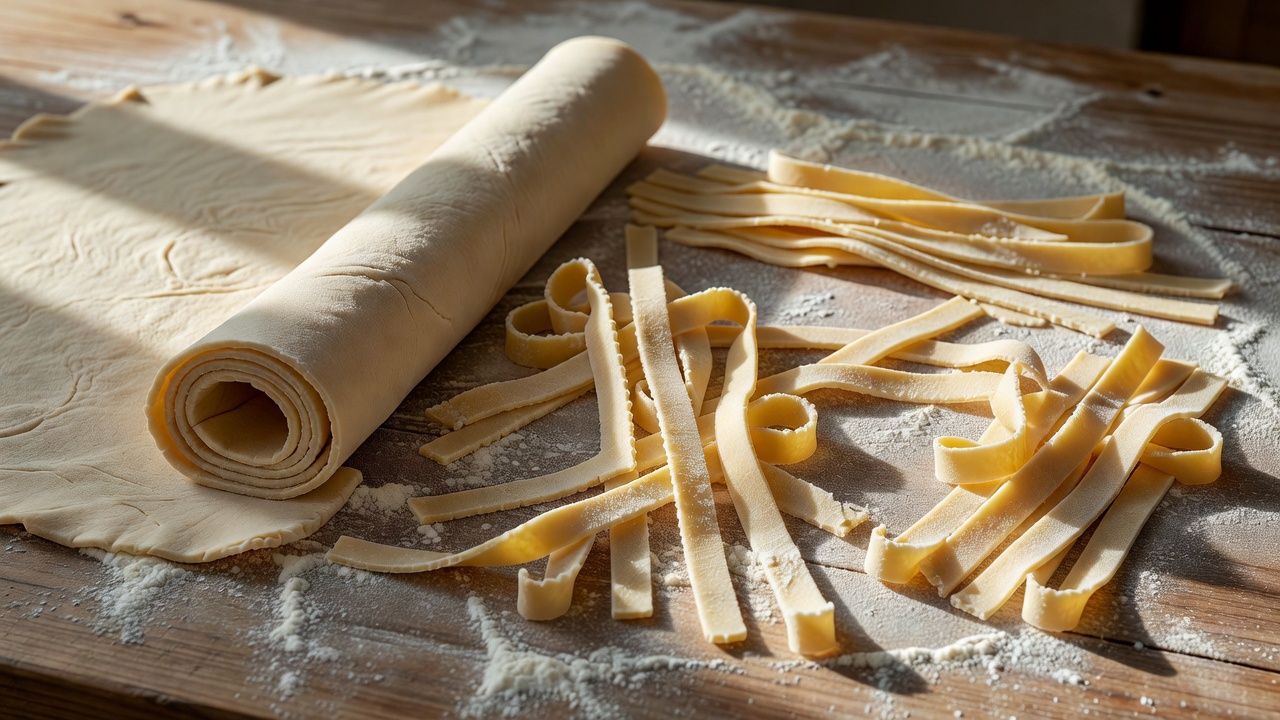
Make the board work for you
Begin with a rested dough, a clean dry board, a rolling pin, a sharp knife and a small bowl of dusting flour. Set the board on a nonslip support if it moves. Clear enough space to rotate the sheet without dragging it across other ingredients. Keep unused dough covered so the last portion does not become a different, drier experiment.
Divide a small batch into two or more pieces if your board is narrow. A manageable piece is easier to roll evenly than a broad sheet hanging over the counter. Press it into a thick oval or rectangle with your palm. Inspect the edges before rolling: deep cracks at this point suggest a dough issue, not a need for more pressure.
Move from the center outward
Dust the board lightly and roll from the middle toward an edge. Return to the middle and work in the opposite direction. Rotate the dough frequently, lifting it fully so you can check whether it has started to stick underneath. Use just enough flour to keep movement clean. Heavy dusting can disguise damp patches and make the outside chalky.
Apply pressure in passes rather than trying to reach the final thickness immediately. Watch for ridges made by repeatedly stopping the pin in the same place. Roll across those ridges gently and compare the middle with the perimeter. If the sheet shrinks back after every pass, cover it and wait about 15 minutes before trying again.
A pasta machine is optional. If you use one, follow its operating instructions, begin at a wide setting and reduce the gap gradually. Setting numbers are not standardized across machines, so “setting six” is a poor measurement to share without naming the machine. Never put fingers or tools near moving rollers, and keep electric parts dry.
Keep width separate from thickness
A noodle can be wide and thin, narrow and thick, or somewhere between. Width changes how it gathers sauce and feels across the tongue; thickness strongly affects how quickly heat reaches the center. For an initial rolled wheat noodle, a sheet around 1–2 mm thick is a useful comparison range, not a definition of every style.
These bars are diagrams, not screen rulers. Check the dough’s actual edge with a clean ruler where practical. For a controlled comparison, roll one portion thinner and leave another thicker while cutting both to the same width. Cook samples separately and record the time at which each loses its dry center.
Do not judge readiness by translucency alone. Whole-wheat dough, egg dough and strongly colored variations show light differently. Your fingers and the cut edge provide useful evidence even when you cannot see a shadow through the sheet.
Cut a loose stack
Dust the surface lightly, then fold the sheet back and forth into loose layers. Avoid pressing the folds flat. If the dough is very tacky, leave it unfolded for a brief surface-drying pause while you watch closely. It should become less sticky, not leathery or brittle.
Place the stack securely on the board. With fingertips curled away from the blade, make steady downward cuts of a consistent width. A sharp knife reduces the temptation to crush the layers, but it still requires careful handling. Cut a few ribbons, unfold them and check that they separate before continuing through the entire stack.
Toss the opened strands lightly with a little flour if needed, then arrange them in loose portions. Do not compress damp noodles into tight nests. If the layers fuse, stop and investigate surface moisture or insufficient dusting rather than cutting faster. Very thin sheets can also be cut flat with an appropriate pasta cutter.
Let the bowl confirm the board
Bring a roomy pot of water to a boil and add a small test portion. Stir gently at the beginning to separate strands. Avoid crowding the pot so heavily that the noodles clump or the water takes a long time to recover. Exact cooking time depends on thickness, formula and how much the surface has dried.
Remove a sample, let it cool enough to taste safely and check the center. A dry, floury core means it needs more cooking; a resilient but fully hydrated bite may be the intended texture. Floating alone does not prove doneness. Once you like the result, cook the remaining portions in comparable batches and bring them promptly to the sauce or broth.
For storage, refrigerate promptly or freeze separated portions rather than attempting to make thick fresh noodles shelf-stable on the counter. Home air-drying is not automatically a validated preservation method. Keep the shaping experiment about texture, not about guessing whether a damp center is safe to store.