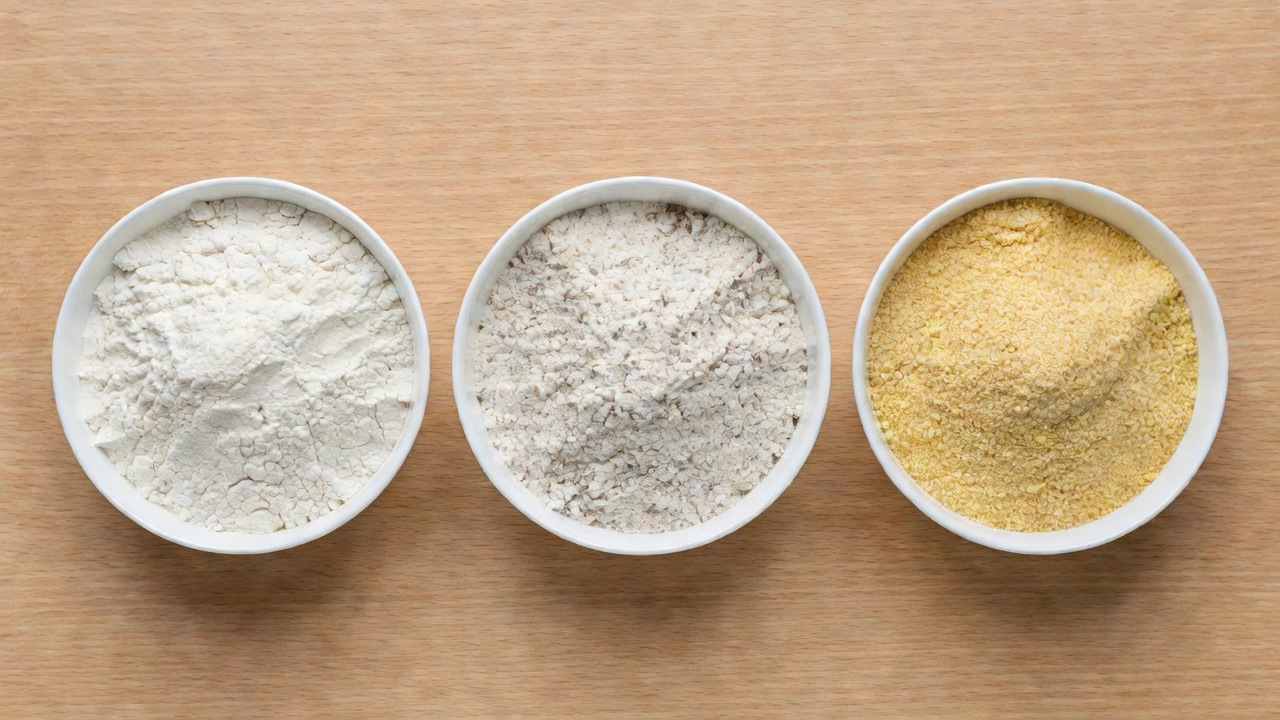
Start with a dependable middle
For your first hand-cut wheat noodles, ordinary all-purpose flour is a sensible choice. It usually offers enough structure to roll and lift without making every movement a wrestling match. Use an unseasoned wheat flour, not a self-raising blend. Added raising agents change the dough in ways that make a simple comparison less useful.
Protein percentage is a clue, not a complete prediction. Wheat variety, protein quality and milling all influence performance. A bread flour with a higher listed protein may make a firmer, more elastic sheet, but that strength can also increase spring-back. A very soft flour may roll easily yet tear when handled thinly. Your target is a workable balance, not the biggest number on the packet.
Separate strength from grind
| Flour | Useful tendency | Watch for |
|---|---|---|
| All-purpose wheat | Balanced handling for rolled noodles | Differences between brands |
| Bread flour | Firm, elastic structure | More resistance during rolling |
| Durum semolina | Distinct bite in water-based pasta | Coarse particles hydrating slowly |
| Whole wheat | Bran flavor and a more textured sheet | Greater water demand and edge tearing |
The Italian label “00” describes a milling classification; it is not a universal promise of high or low gluten strength. Read the intended use and the producer’s information. Finely milled durum, sometimes labeled semola rimacinata, behaves differently from coarse semolina even though both come from durum wheat.
Likewise, do not assume every flour sold for Asian noodles is interchangeable. Udon, alkaline ramen and hand-pulled noodles rely on different balances of strength, hydration and processing. A single flour can serve several purposes, but the method must suit the intended noodle.
Run a two-bowl trial
Weigh 100 g of all-purpose flour into one bowl and 100 g of bread flour into another. Add 48 g of room-temperature water to each. This is a trial ratio for a firm rolled water dough, not a guarantee that every flour will cooperate at that hydration. Leave salt out of this first comparison so it does not become another variable.
Mix each bowl for the same amount of time, press the crumbs together and cover both for 30 minutes. Knead briefly, then compare a small flattened piece from each. Record dry crumbs, surface cracking, stickiness and how far the piece recoils after stretching. Do not quietly add extra water to only one bowl and then attribute the result entirely to flour.
If a batch cannot cohere after resting, add water in measured 1–2 g increments and record the final total. That adjustment is useful evidence. It tells you the original fixed-water trial was not equally workable for both materials; it does not mean the flour failed.
Let variations earn their place
Begin a whole-wheat comparison by replacing 20 g of a 100 g white-flour batch with whole-wheat flour. Keep the rest of the method steady. Bran can interrupt the gluten network, so expect a different edge and a less silky surface. Rest before deciding whether extra water is necessary. For a second trial, adjust hydration deliberately rather than adding liquid by habit.
Buckwheat is not wheat and does not form wheat gluten. Soba traditions include both wheat-blended and all-buckwheat noodles, but a pure buckwheat dough asks for different handling. For a beginner’s blended experiment, a small substitution is easier to evaluate than a complete replacement. Buckwheat and wheat can both cause allergic reactions; a blend is not suitable for someone avoiding wheat.
Egg pasta deserves a separate baseline because egg brings protein and fat as well as water. Chickpea, rice and other gluten-free flours are not direct substitutes in this wheat-dough method. Seek a method designed for those ingredients rather than trying to repair an incompatible dough indefinitely.
Finally, keep flour dry, sealed and away from strong odors. Whole-grain flour’s oils can develop stale or rancid aromas sooner than refined flour. Discard flour that smells rancid or shows pest activity. Raw flour is not ready-to-eat: resist tasting uncooked dough, wash your hands and clean the work surface after handling it.