Weigh a small, readable batch
Start with 100 g all-purpose wheat flour and 48 g room-temperature water. The small quantity makes the experiment manageable and keeps corrections visible. This firm water-dough baseline is intended for rolled, hand-cut noodles. It is not a formula for every noodle style, and some flours will need a little more water to become workable.
In baker’s percentage, hydration is water weight divided by flour weight, multiplied by 100. Here, 48 divided by 100 gives 48% hydration. If you double the flour to 200 g, 96 g water preserves that ratio. Measure in grams rather than cups: flour packing and egg size make volume measurements less useful for comparisons.
Keep salt out of the first test if you want the simplest possible baseline. Later, you can compare a salted batch with an otherwise identical unsalted one. Dissolve any measured salt in the water first, and note it separately rather than silently changing the formula.
Look for clumps before smoothness
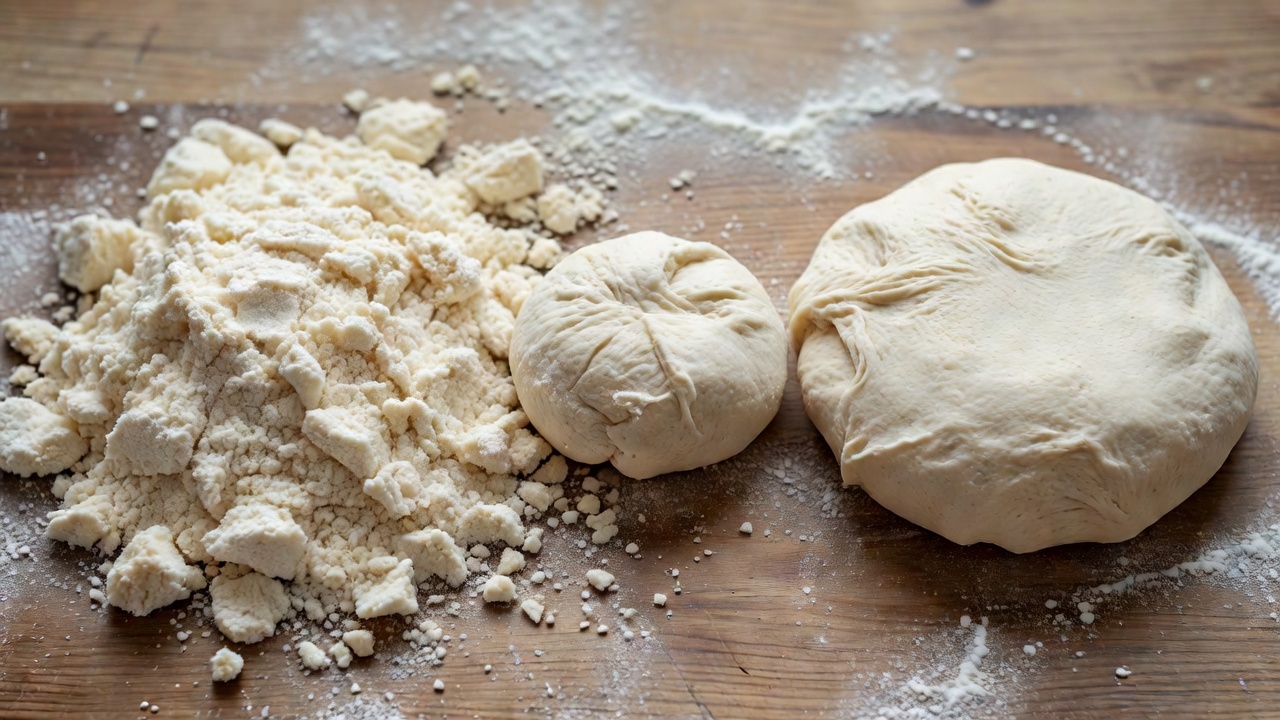
Add the water gradually while stirring with chopsticks, a fork or your fingertips. Scrape dry flour from the bottom of the bowl into the damp pieces. At first, the mixture may resemble coarse crumbs. Squeeze a handful: if it holds together, you have a more useful sign than an untidy surface.
Press the crumbs into a mass, using the heel of your hand or a bowl scraper. Work over a stable surface without forcing your wrists into an uncomfortable angle. Cover the dough for about 10 minutes, then knead for a few minutes until the parts join more readily. Fold, press and turn; there is no need to tear the mass apart with every movement.
If dry flour still refuses to join after this short covered pause, add 1–2 g water, distribute it carefully and record the change. A wet patch needs time to spread. Avoid alternating handfuls of flour and splashes of water, which can grow the batch without ever making its hydration clear.
Give hydration and relaxation time
Cover the joined dough and let it rest for about 30 minutes as a first trial. An inverted bowl or a reusable covered container prevents the outside from drying. A damp cloth should not drip onto the dough. Mark the start time so “a short rest” becomes a repeatable observation.
During rest, water continues moving through the flour and the worked dough can become easier to extend. To see this rather than simply trust it, flatten a small piece before the rest and another afterward. Use the same pressure. Compare the length, edge cracks and recoil. A dough that stretches farther after resting may not need additional water at all.
Do not leave raw dough out indefinitely. Count mixing, resting and shaping together when tracking room-temperature handling. As a conservative food-safety limit, refrigerate perishable dough within two hours, or one hour above 90°F / 32°C. Egg-containing dough needs particular care. Keep longer rests covered in the refrigerator, and allow for firmer handling when cold.
Egg is an ingredient, not just liquid
For a separate egg-pasta trial, begin with 100 g all-purpose flour and 50–55 g beaten whole egg weighed without its shell. Egg composition and flour absorption vary, so this is a starting range rather than a promise. Mix, cover and assess using the same patient sequence. If correction is needed, add a little water in measured increments.
Do not label a dough made with 50 g egg and 100 g flour as “50% water hydration.” Whole egg is only partly water; its proteins and fats also influence the dough. For a home notebook, recording the exact egg and added-water weights is clearer than pretending the two liquids are identical.
An egg dough often feels richer and changes color, but color alone does not prove it is ready to roll. Look for a cohesive interior, an uncrusted surface and a piece that flattens without breaking into dry layers. It can remain quite firm. A perfectly glossy ball is not a prerequisite for every rolled noodle.
Stop correcting and test a sheet
Divide the rested dough into manageable portions and keep unused pieces covered. Flatten one portion and begin rolling. If it repeatedly recoils, pause and cover it again instead of increasing force. If it tears at dry seams, return to the hydration notes before dusting it with more flour.
Raw flour and raw egg can carry harmful germs. Do not taste uncooked dough; clean hands, bowls and the board after preparation. Refrigeration does not make raw dough safe to eat. The final test belongs in a properly cooked strand, not in a bite from the mixing bowl.